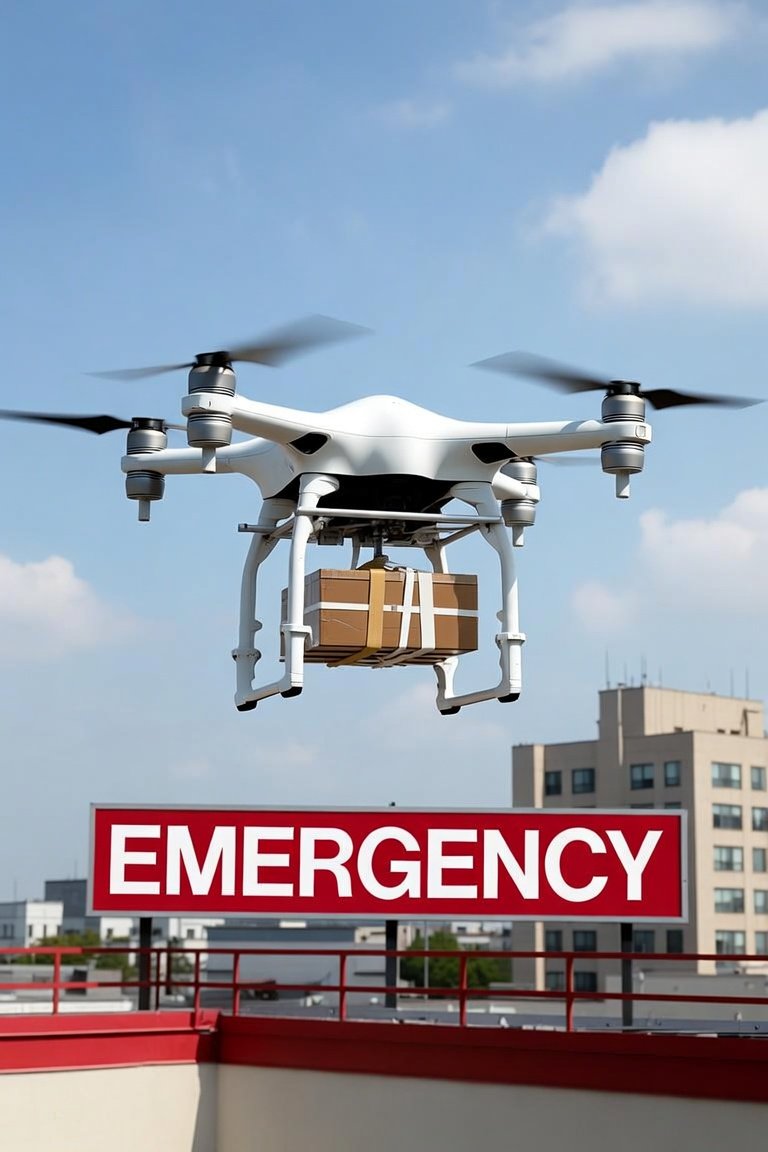
I have spent two decades in medical technology, watching defibrillators shrink from cart-sized behemoths to devices you can hold in one hand. But nothing has prepared me for the quiet revolution happening in the sky. Medical drones are no longer a futuristic concept. They are a practical, rapidly maturing tool for emergency response, and I have seen them shave critical minutes off response times in ways that ground ambulances simply cannot match.
The core advantage is speed and access. A drone can fly at 60 to 80 miles per hour in a straight line, bypassing traffic, road closures, and difficult terrain. For a cardiac arrest patient, every minute without defibrillation reduces survival chances by 7 to 10 percent. I have worked with systems where a drone carrying an automated external defibrillator, or AED, arrives at a scene in under four minutes, while the nearest ambulance is still ten minutes out. The practical impact is undeniable.
Key features to understand are payload capacity, flight time, and autonomous navigation. Most emergency medical drones are quadcopters or hexacopters designed to carry between 2 and 5 kilograms. This is enough for an AED, a tourniquet kit, naloxone, or a small blood cooler. Flight time is typically 20 to 40 minutes, which covers a radius of about 5 to 10 miles from the base station. The real innovation is in the flight control software. These drones use GPS, cellular networks, and onboard cameras to navigate autonomously to a precise location, often landing within a few feet of the patient. Some models can lower the payload on a tether, so the drone hovers overhead and drops the equipment safely.
When comparing options, you will find two primary categories. First are the integrated systems from companies like Matternet and Zipline. These are turnkey solutions that include the drone, the base station, the charging pad, and the dispatch software. They are expensive, often costing over $100,000 per unit, but they are reliable and certified for beyond-visual-line-of-sight flight. Second are the modular platforms, such as modified DJI M300 or M600 drones, fitted with specialized medical payload boxes. These are more affordable, around $20,000 to $40,000, but require more technical expertise to integrate and maintain. For a hospital system or EMS agency, I recommend starting with a modular platform to test workflows before committing to a full integrated system.
What you must look for is regulatory compliance and failsafe redundancy. In the United States, the FAA requires a Part 107 waiver for commercial drone operations, and a specific waiver for beyond-visual-line-of-sight flight. The drone must have multiple layers of safety: a parachute system for catastrophic failure, redundant flight controllers, and a return-to-home function that activates if the communication link is lost. I have seen too many projects fail because they ignored the regulatory hurdles. Partner with a certified drone service provider who understands medical logistics, not just aerial photography.
In closing, if you are evaluating medical drones for your emergency response fleet, start small. Choose a single drone, a defined geographic area, and a specific use case like AED delivery to cardiac arrest calls. Track your response times for six months. I have seen this approach cut time-to-defibrillation by an average of 5 minutes in suburban zones. That is five minutes of brain survival. The technology is ready. The question is whether your team is ready to integrate it into your dispatch protocols.
Innovations & Tech
Medical Drones Take Flight in Emergency Response