If you have stepped into an operating room in the last eighteen months, you have likely noticed that the conversation has shifted from whether artificial intelligence will change surgery to how quickly you can integrate it safely. We are past the hype cycle. The current generation of AI-assisted platforms is not a futuristic concept; it is a tangible tool that affects your intraoperative decisions, your documentation burden, and your patient outcomes. As someone who has spent two decades installing and servicing these systems, I want to give you a grounded, practical overview of what works, what does not, and what you should demand from your hospital’s purchasing committee.
The most significant shift is that AI has moved from being a passive observer to an active participant in the workflow. The key features you will encounter today fall into three distinct categories. First, there is real-time anatomical tracking, where the system uses preoperative imaging fused with intraoperative video to highlight critical structures like ureters or vascular bundles, reducing the cognitive load of mental registration. Second, there is automated tissue characterization, which uses optical coherence or hyperspectral imaging to differentiate between healthy and ischemic tissue, giving you an objective read on perfusion before you fire a stapler. Third, and perhaps most impactful for your daily practice, is intelligent video capture that automatically labels phases of the operation, creating a searchable surgical record without you touching a keyboard. These are not theoretical benefits; they are measurable reductions in operative time and anastomotic leak rates in recent multicenter trials.
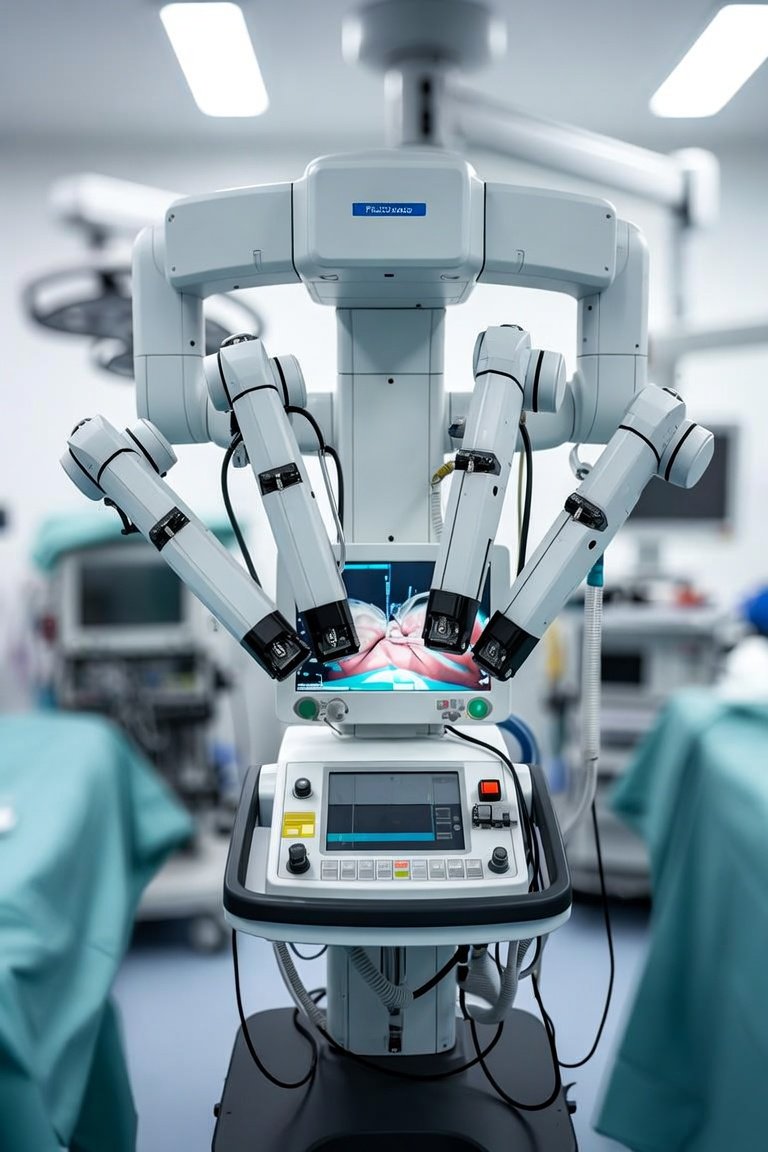
When you compare the major platforms, the differences are more about integration than raw capability. The robotic systems from the major vendors offer closed-loop AI that assists with camera control and instrument tracking, but they require you to stay within their proprietary ecosystem. In contrast, the newer open-platform AI modules are agnostic, attaching to your existing laparoscopic tower or endoscope and providing overlay guidance on any standard monitor. The trade-off is significant. A closed-loop system offers tighter latency, often under 50 milliseconds, which feels instantaneous. An open platform may have slightly higher latency, usually around 100 to 150 milliseconds, but it allows you to keep your existing instruments and costs roughly sixty percent less. For a community hospital, the open platform is often the smarter first step. For a high-volume academic center, the closed-loop system’s predictive alerts, such as warning you about an impending collision with the diaphragm, are worth the premium.
What should you look for when evaluating these systems? Ignore the marketing slides about deep learning and focus on three practical specifications. One, look at the false positive rate for alerts; a system that alarms too frequently will be disabled by your staff within a week. Demand a rate below five percent. Two, check the data storage architecture. The system should offer local edge processing, meaning the AI runs on a dedicated GPU cart in the OR, not in the cloud. This protects patient data and ensures functionality even if the hospital network goes down. Three, verify the training dataset. The algorithm must have been trained on your specific surgical approach, whether that is laparoscopic, robotic, or open, and ideally on the same anatomical region. A model trained predominantly on bariatric cases will not serve you well in a colorectal resection.
Ultimately, AI-assisted surgery is a force multiplier for your judgment, not a replacement for it. The technology excels at pattern recognition and eliminating the drudgery of documentation, but it still relies on your hands for haptic feedback and your brain for nuanced decision-making. My recommendation is to start with a pilot program. Choose one high-volume, low-complexity procedure, such as laparoscopic cholecystectomy, and run the AI overlay for thirty cases. Track your own conversion rates and operative time. You will find that the technology earns its place, not by making you faster, but by making you more consistent. That consistency is the real promise of this generation of surgical technology, and it is available now.
Innovations & Tech
The Operating Room’s New Teammate: Practical Guidance on AI-Assisted Surgery