Walk into any operating room today and you will see more screens than scalpels. The promise of artificial intelligence in surgery is no longer theoretical; it is embedded in robotic arms, imaging systems, and even the anesthesia cart. But for the practicing surgeon, the question is not whether AI works, but how to use it without losing the tactile judgment that defines our craft.
The core value of AI in the operating theater is not autonomy; it is augmentation. Think of it as a highly trained fellow who never tires, never blinks, and has memorized every relevant paper from the last decade. The most mature applications fall into three categories: intraoperative navigation, tissue perfusion assessment, and complication prediction. In real-world use, AI-driven navigation systems now fuse preoperative CT or MRI data with live endoscopic video, overlaying critical structures like vessels and ureters in real time. This is not science fiction; systems like the Medtronic Touch Surgery Enterprise and Stryker’s SmartRobotics are already doing this in thousands of cases weekly. The practical benefit is a measurable reduction in inadvertent injury during laparoscopic cholecystectomies and colorectal resections.
For tissue assessment, indocyanine green fluorescence is being paired with machine learning algorithms that quantify perfusion objectively. Instead of a subjective “looks pink enough,” the AI provides a numeric perfusion index, flagging ischemic segments before an anastomotic leak becomes a week-long ICU stay. This is the kind of feature that pays for the capital investment in a single avoided complication.
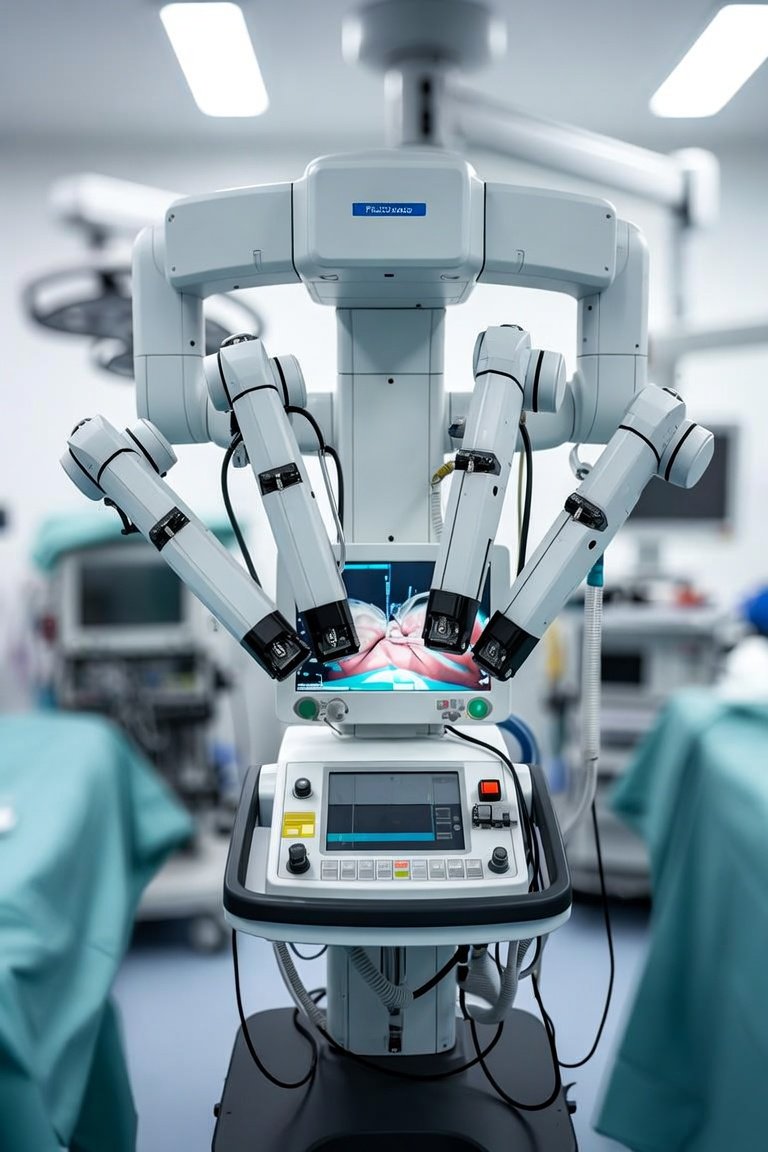
Now, let us compare the main platforms you will encounter. On the robotic side, the Intuitive Da Vinci Xi with its Firefly fluorescence and AI-driven case analytics remains the benchmark, but the new entrant, the Asensus Senhance, offers haptic feedback and eye-tracking camera control, which many surgeons find more intuitive. The key difference is data: Da Vinci has a decade of procedural data to train its algorithms, while Senhance offers a lower per-case cost and an open console. If you are in a high-volume center, the Da Vinci ecosystem is the safer bet. If you are in a community hospital with budget constraints, the Senhance or the CMR Versius (which uses a modular arm design) gives you 80 percent of the capability at 60 percent of the price. Do not overlook the non-robotic options either; the Stryker 1688 4K camera system with AI image enhancement is a cost-effective upgrade for existing laparoscopic towers, sharpening edges and reducing noise without changing your workflow.
When evaluating any AI-assisted system, focus on three practical criteria. First, does the AI require a separate data pipeline, or does it integrate with your existing EHR and PACS? A system that demands manual data transfer will be abandoned by your staff within a month. Second, what is the false-positive rate for alerts? An AI that alarms on every minor deviation will be muted, rendering it useless. Ask for the vendor’s published sensitivity and specificity data, not just marketing slides. Third, consider the learning curve for your OR team. The best AI is invisible; if your scrub nurse needs a two-day course to set up the system, you will not use it for your 7 AM case.
The bottom line is that AI will not replace surgeons, but surgeons who use AI will replace those who do not. Start small. Pick one procedure, one AI feature, and run it for ten cases. Track your operative time, complication rate, and your own mental fatigue. The technology is mature enough to be a reliable partner, but it still needs a captain. Your hands remain the final safety check, and no algorithm will ever replace the judgment that comes from a decade of complications and successes. Embrace the data, but trust your instincts. That combination is the future of surgery, and it is already in your OR.
Innovations & Tech
AI-Assisted Surgery: Separating the Hype from the Hardware